Drip irrigation for hedges and shrubs: design and installation
How to put a hedge or shrub bed on drip: pressure-compensating emitters in GPH, dripline vs point emitters, a drip zone kit with filter and 25-30 PSI regulator, run length limits and how long to water.

Why drip suits hedges and shrubs
Hedge and shrub roots sit mostly in the top 12 to 16 inches of soil and spread sideways. A lawn spray head throws its water over a whole arc, and most of it lands on leaves or on the gaps between plants instead of the root zone. You get wasted water, wet foliage that invites fungal disease, and uneven growth because some plants catch more spray than others.
Drip puts the water at the base of each plant through small emitters. Very little evaporates, the leaves stay dry and every plant gets a measured amount. That is also why many water utilities treat drip more leniently in their watering restrictions; check what yours allows before you set the schedule.
Point emitters or dripline
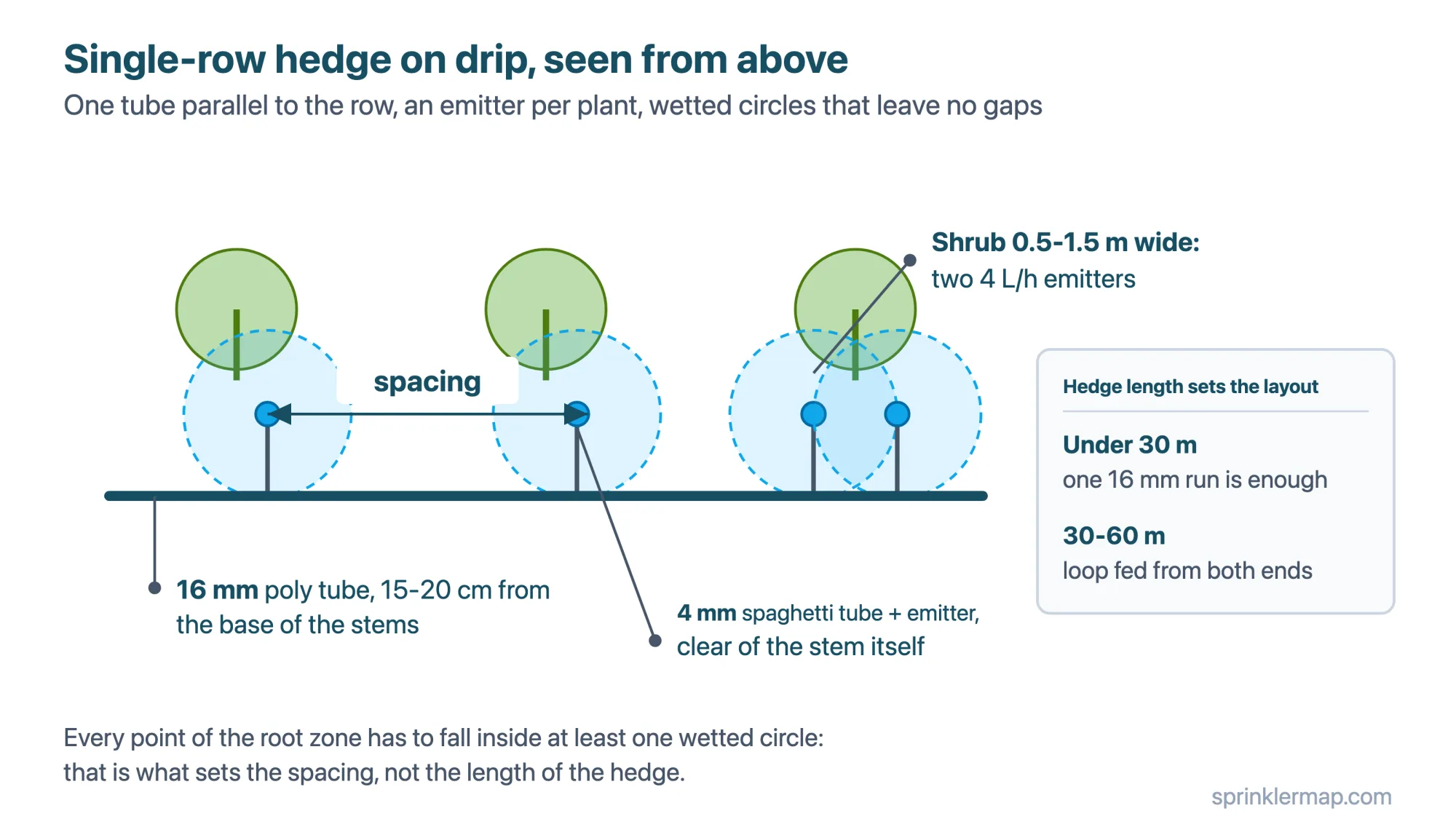
Point emitters press into 1/2 in poly tubing and put out a fixed flow, most commonly 0.5, 1 or 2 GPH. They suit shrubs planted with gaps between them: one 0.5 GPH emitter for a young shrub under about 20 in across, two 1 GPH emitters on opposite sides for an established shrub 1.5 to 5 ft wide, and three or four in a ring at the drip line for large specimens or small trees. For plants away from the tube, run 1/4 in micro tubing from the main line and stake the emitter at the plant.
Dripline has emitters built in at a fixed spacing, often 12 or 18 inches. It is the easy answer for a continuous single-row hedge, where placing individual emitters would be tedious: lay it along the stems, connect it to the 1/2 in supply and cover it with mulch.

Pressure-compensating emitters
Use pressure-compensating (PC) emitters on hedges. A PC emitter keeps its rated flow over a wide pressure range, typically around 15 to 50 PSI, so the first plant and the last one get the same water.
A non-compensating emitter does not. Its flow rises and falls roughly with the square root of the pressure: if the far end of a long hedge runs at 15 PSI while the start sees 30 PSI, the emitters at the end put out about 30% less. On a long or sloping hedge that is the difference between a row that grows evenly and one that thins out at the far end.
The drip zone: valve, filter, regulator
Every drip zone starts with the same three parts after the valve: a filter, usually 150 to 200 mesh, to keep grit out of the emitters; a pressure regulator, usually 25 or 30 PSI, because house pressure is far too high for drip fittings; and then the 1/2 in tubing. Manufacturers sell all three pre-assembled as a drip zone control kit, which is the simplest way to add a drip zone to an existing sprinkler manifold.
For a single-row hedge, run the 1/2 in tubing parallel to the row, 6 to 8 inches from the stems. Finish each run with a flush cap or a figure-8 end you can open once or twice a season to flush out sediment.
Run length and flow: the limits of 1/2 in tubing
Total zone flow is simply the number of emitters times their flow. A 130 ft hedge on dripline with 0.5 GPH emitters every 12 inches has about 130 emitters, so 65 GPH, a little over 1 GPM: far below what a house supply delivers (usually somewhere between 5 and 12 GPM at the outdoor tap) and well within any zone valve.
The tubing sets the real limit. Manufacturers typically rate 1/2 in drip tubing at around 200 GPH and runs of about 200 ft from where the water enters; beyond that, pressure at the far end drops too far even for PC emitters. If your hedge is longer, feed the tubing from the middle, loop it back to the start so it is fed from both ends, or split it into two zones. Check the numbers for your brand, because tubing sizes differ slightly between manufacturers.
Mixed shrub beds
For an irregular bed, run the 1/2 in tubing through it as a spine and branch 1/4 in micro tubing to each plant, ending in a staked emitter. You choose the number of emitters plant by plant: one for small plants, two for medium ones, three or four for large specimens.
It takes longer to install than a single dripline, but it is the only layout that copes with a bed where a lavender sits next to a hydrangea. Plants with very different water needs still belong in different zones; how to group them is in Hydrozones: split your garden to irrigate better.
How long and how often to water
Established shrubs do best with deep, infrequent watering. Water that soaks down draws the roots deeper, and deeper roots ride out hot spells and need less water in cool weeks.
Work out the gallons per plant from the emitters: number of emitters × GPH × hours. A 3 ft shrub with two 1 GPH emitters running for an hour gets 2 gallons. In summer, a common starting point for established shrubs is one or two such sessions a week, then you adjust by checking the soil a few inches down a day after watering: it should be moist, not soggy. New plantings need more frequent watering, often every two or three days, until their roots reach into the surrounding soil, usually the first four to six weeks. To turn soil type into run times, see How long to run sprinklers: minutes per cycle by soil and head type, with the math behind them.
Frequently asked questions
Can a hedge drip line share a zone with lawn spray heads?
No. Drip runs at about 20-30 PSI behind a regulator, spray heads want around 30 PSI or more at the nozzle, and the run times differ by an order of magnitude: minutes for sprays, an hour or more for drip. Each needs its own valve.
My hedge mixes old shrubs and new plantings in the same row. How do I water both?
Use point emitters instead of a uniform dripline, so each plant gets its own flow: a 1 GPH emitter or two 0.5 GPH emitters for a new planting, 0.5 GPH for an established shrub that only needs topping up. Once the new plants have rooted in, after a season or two, swap their emitters to match the rest.
How do I check that the emitters are working?
Run the zone for 15 minutes, then pull back the mulch at a few emitters: each should have a damp patch of soil 4 to 6 inches across. A dry spot means a clogged emitter, and clogged emitters almost always start with a dirty filter, so clean the filter before replacing anything.
Recommended products
These product links are affiliate links: if you buy on Amazon or AliExpress through them it costs you nothing extra, but it helps us keep SprinklerMap alive as a project and create new useful content.
These products are catalogued in our brand database, with the same description and price range you find on the manufacturer page.

| Model | Type | Description | Radius (m) | Price (€) | Buy |
|---|---|---|---|---|---|
| 🌿 XF Dripline | Drip | Pressure-compensating drip line for beds and hedges. Uniform flow from 0.5 to 5 bar pressure. | — | €90-160 | Amazon |

| Model | Type | Description | Radius (m) | Price (€) | Buy |
|---|---|---|---|---|---|
| 🌿 Techline CV | Drip | Pressure-compensating drip line for landscaping and vegetable gardens. 1.6 L/h flow, 30 cm spacing, works from 0.7 to 4 bar. | — | €90-170 | Amazon |
Other suggested products
Products not in the brand catalogue: generic material, tools and accessories where the right size matters more than the brand.
| Product | Description | Price (€) | Buy |
|---|---|---|---|
| Rain Bird pressure-compensating emitters 0.5 GPH (25-pack) | Rain Bird pressure-compensating drip emitters, 0.5 GPH, steady output across the normal drip pressure range. UV-resistant body with a barb that presses into 1/2 in poly tubing. For long hedge runs where the last plant must get the same water as the first. | ~€15-25 | Amazon |
| Netafim 1/2 in dripline, 12 in emitter spacing | Netafim dripline with built-in emitters at a fixed spacing. Lay it along a continuous hedge, connect it to the drip zone and cover it with mulch. Check the emitter flow and spacing on the listing, they vary by model. | ~€40-70 / 100m | Amazon |
| Y-filter 3/4 in, 150-200 mesh, for drip irrigation | Y-filter for drip zones, 3/4 in connections, with a screen you can rinse without taking the filter off the line. Goes right after the zone valve, before the pressure regulator. | ~€8-18 | Amazon |
| 1-zone battery-powered timer for standalone drip | Single-zone battery-powered timer that screws onto an outdoor faucet. A simple way to run a hedge on drip without wiring a new zone into the controller. | ~€20-40 | Amazon |
| Product | Description | Price (€) | Buy |
|---|---|---|---|
| Drip line 16 mm, 30 cm spacing | Roll of pipe with built-in emitters for continuous runs along hedges and rows. Check the stated spacing: under 2 L/h the flow is less forgiving. | ~€12-35 | AliExpress |
| Y filter 3/4", 120 mesh | Washable screen filter to fit upstream of any drip line: without it, emitters clog within a season. | ~€6-15 | AliExpress |
| Battery tap timer, single zone | Battery-powered mechanical or digital timer for one line: useful on a terrace, hedge or veg patch where running power makes no sense. | ~€10-25 | AliExpress |
Technical note: Emitter flows, pressure ranges and maximum run lengths vary by manufacturer and tubing size: the figures here are typical values from published product specs. Watering amounts depend on your soil, climate and plant species; use them as a starting point and adjust by checking soil moisture in the first weeks. Some cities treat drip differently in their watering restrictions, so check your utility's rules.