What grass does Wimbledon use, and how do they water it?
100% perennial ryegrass, an 8 mm cut and a separate irrigation program for every court: how the All England Club decides how much water its grass gets, and what you can borrow for your own lawn.
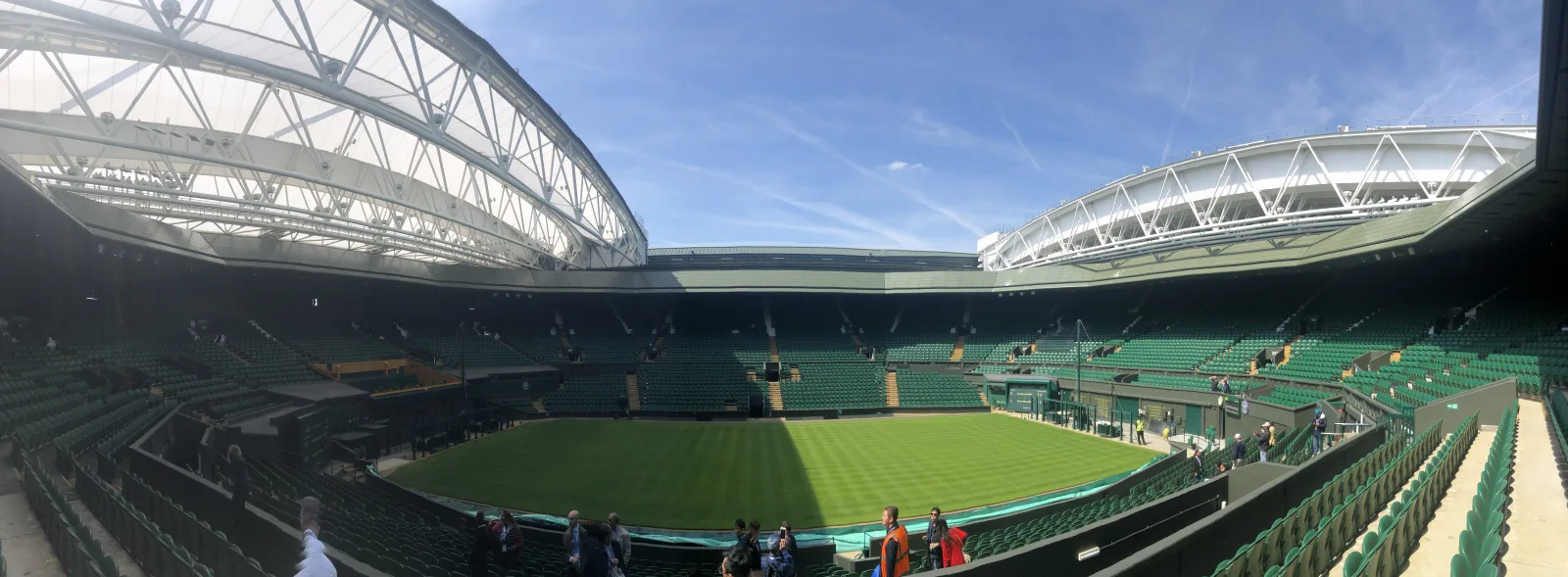
Wimbledon by the numbers: what's under the 38 grass courts
The All England Lawn Tennis Club (AELTC) looks after 38 grass courts: the 18 used during the Championships and 20 practice courts. A permanent grounds team of 18 people grows to 31 for the tournament. Each year the courts take 10 tonnes of seed and 200 tonnes of soil for leveling. Under the turf sits 275 mm (about 11 in) of soil with 18% clay, and by the start of the Championships the roots reach 200 mm (about 8 in) deep.
Those figures come from the media fact sheet the club published in 2023 on court preparation, and they describe turf that is managed by measurement. Part of that approach carries over to a back yard, especially the way the staff decide how much water each court gets.

What grass Wimbledon uses: 100% perennial ryegrass since 2001
Until 2000 the courts were sown with 70% perennial ryegrass (Lolium perenne) and 30% creeping red fescue. Since 2001 the club has used perennial ryegrass alone. The change followed independent research by the STRI (Sports Turf Research Institute), which found that straight ryegrass was the best way to fight wear and improve the sward without changing the perceived speed of the court.
Homeowners pick perennial ryegrass for the same reason: it handles foot traffic and establishes fast, which is why it shows up in nearly every play or sports lawn mix. It does cost water. In the SprinklerMap vegetation panel (see Vegetation Types in SprinklerMap: How ET Values Drive Your Watering Schedule) ryegrass has a peak ET of 5.3 mm (0.21 in) per day, against 5.0 for the generic English lawn mix and 4.8 for tall fescue. Among cool-season grasses only golf bentgrass uses more, at 5.5.
On 1,000 sq ft in full sun during the hottest stretch of summer, the app works out about 2 inches of water a week that the sprinklers have to put down, roughly 1,270 gallons. Tall fescue on the same area needs about 1,150. The gap between the two species is around 10%, smaller than the effect of sun exposure or soil type.
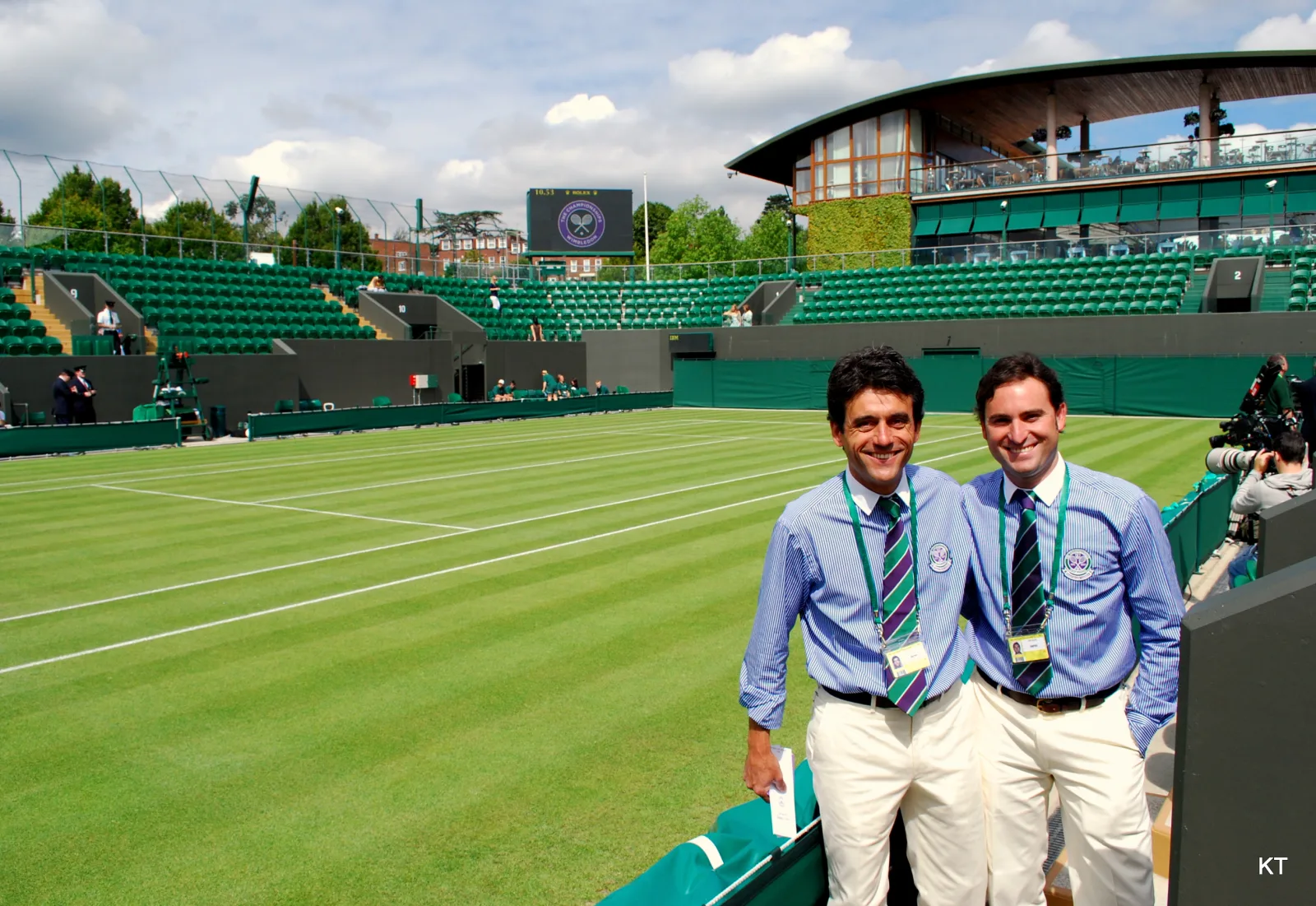
A hard, dry court, on purpose
According to the AELTC, how high the ball bounces depends mostly on the soil, not the grass. To survive 14 days of play without damage the soil has to be hard and dry, so the courts are rolled and covered to keep them firm. The club puts it bluntly: grass is a living surface and has to sit on the tipping point of stress to give the best playing surface.
During the final preparation week and throughout the tournament the STRI takes daily readings on every court. Hardness is measured with a Clegg impact hammer, and on day one of the Championships it should read between 170 and 220 gravities. Centre Court, No.1, No.2, Court 6 and Court 14 have access tubes for a probe that reads volumetric soil moisture from 50 to 400 mm deep (about 2 to 16 in), because soil moisture directly affects hardness, live grass cover and ball rebound.
A home lawn has the opposite goal: it should stay green with little fuss, so Wimbledon's moisture target is not one to imitate. The way they work is. They measure first and then decide how much to water.

Every court has its own irrigation program
The AELTC fact sheet says each court now has its own irrigation program, so water can be targeted. In early July 2026, after England's warmest June on record, head of courts Neil Stubley explained the logic to the Associated Press: if Court 14 reads firmer than Centre Court, Court 14 gets more water and Centre Court gets less. Two courts with the same grass and the same soil get different amounts because the readings say so.
In a yard the differences between areas are much larger. The front lawn in full sun, the strip on the north side of the house and the beds under trees need different amounts of water before you measure anything; SprinklerMap applies a factor of 0.8 for partial shade and 0.6 for full shade. If they all run on the same valve they get the same minutes, and some part of the yard will always be too wet or too dry. How to group areas with similar needs is covered in Hydrozones: split your garden to irrigate better.
A back-yard version of Wimbledon's moisture probes
You don't need a probe to start. The first reading is how much water each zone actually puts down: set a few straight-sided cans on the lawn, run the zone for a fixed time and measure what collects. The full method is in The catch-cup test: measure sprinkler uniformity and your real inches per hour. The second is the soil itself. The day after watering, a long screwdriver pushed into the lawn should slide in 4 to 6 inches without much effort. If it stops after an inch or two, the water isn't reaching the roots; if the ground is muddy, that zone is getting too much.
With those readings the math is short. Take 1,000 sq ft of ryegrass in full sun on loam, watered by spray heads at about 1.4 in/h. On the hottest days the app calls for 5.3 × 7 ÷ 0.72 = about 51.5 mm, roughly 2 inches, a week, which is about 88 minutes of spray time. On loam that splits into 4 waterings of about 22 minutes. The same grass in partial shade needs about 18 minutes per watering, and with rotors at about 0.5 in/h each full-sun watering grows to about 64 minutes. The full calculation for sand, loam and clay is in How long to run sprinklers: minutes per cycle by soil and head type, with the math behind them.
A few deep waterings push water down and the roots follow it. At Wimbledon, on 11 inches of soil, roots reach 8 inches before the tournament. At home the same logic says to avoid a few minutes every day, unless your soil is sandy and holds very little water.
Why the grass disappears behind the baseline
In the second week of the tournament the areas behind the baselines turn to bare soil while the rest of the court stays green. Players run, stop and slide over the same few yards, and Stubley compares the effect of shoe studs to a cheese grater. The club tracks it closely: during the Championships the baselines are checked for live grass 31,200 times.
The same thing happens at home on the path to the gate or under the swing set. Foot traffic compacts the soil, water soaks in more slowly and runs off, and longer run times won't fix it. Aerate the area before you reseed, and if the path can't move, turn it into a walkway with stepping stones or mulch. There is more on this in How to fix a bare patch in the lawn (including the pre-germinated seed method).
Renovation in August and September
After the tournament every court is renovated in August and September. Since 2017 the staff have also used steam: trialed on four courts, it was extended in 2018 to Centre Court and five others. It helps control weed grasses of the Poa genus and cuts the club's reliance on pesticides. Then the ryegrass is resown, and over winter grow lights and fans over the courts help keep the grass healthy for the next season.
For a cool-season lawn the window is the same: late summer and early fall are the best time to reseed or overseed, while the soil is still warm. What changes is the watering. Until the seed comes up it has to stay moist with short cycles several times a day, then the waterings are spaced out over a few weeks until you're back on the normal schedule. Run times by nozzle type are in Watering new grass seed: how many minutes per zone.

The court lines
The lines aren't painted. A transfer wheel marker applies a white compound containing titanium dioxide, 50 mm (2 in) wide for every line except the baselines, which are 100 mm (4 in). During the tournament every court is re-lined, rolled and mown daily. Those widths fall within the ITF rules, which call for lines between 1 and 2 inches wide and allow baselines up to 4 inches.
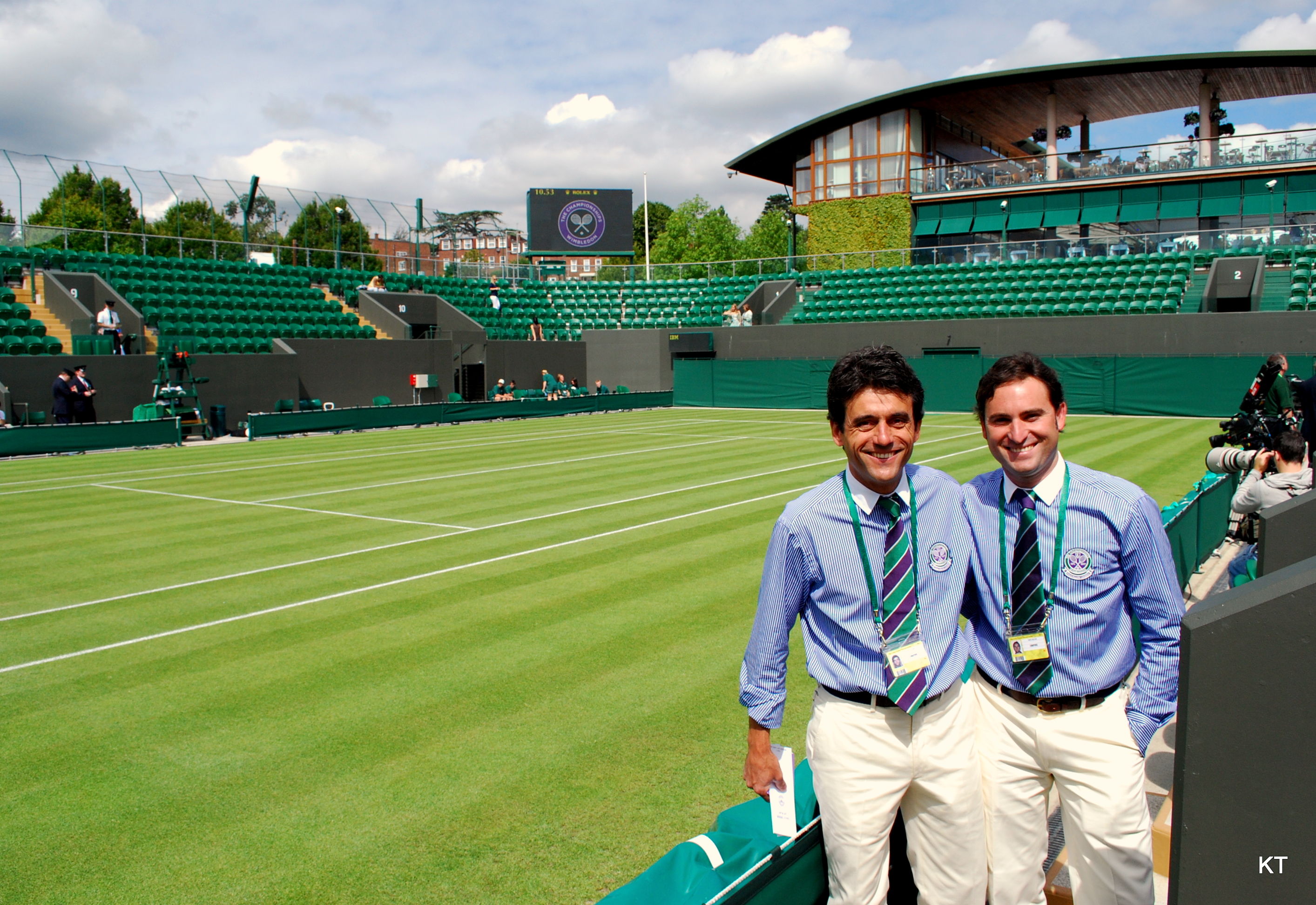
The light and dark stripes
The stripes show up even though the grass is cut to the same height everywhere. The roller behind the blades bends the leaves in the direction of travel. Where the grass leans away from you, you see the broad side of the blade, which reflects more light; where it leans toward you, you see tips and shadows, and that stripe looks darker.
You get the same look at home with any mower that has a rear roller, reel or rotary, by reversing direction on each pass.

What not to copy: the 8 mm cut
The AELTC mows at 8 mm because, according to the research it cites, that height is best for present-day play and for the plant's survival in dry soil. For a home lawn, the UK's Royal Horticultural Society warns that mowing too close weakens the grass, encourages shallow roots and leaves the lawn more exposed to drought, weeds and moss. Its rule is never to take off more than a third of the grass height in one cut, and in hot weather to raise the blades or stop mowing for a while.
Wimbledon's ryegrass you can sow, and its approach to water you can copy. The cutting height and the hard court surface exist for tennis; a lawn that has to make it through August needs taller grass and soil that holds water. For a comparison of seed mixes, see Choosing lawn seed by sun, water and wear: species, labels and mixes.
Frequently asked questions
What grass does Wimbledon use?
Perennial ryegrass (Lolium perenne), 100% since 2001. Before that the courts were sown with 70% ryegrass and 30% creeping red fescue. The club switched after independent research by the STRI showed that straight ryegrass would stand up better to wear.
How short is the grass at Wimbledon?
It is cut to 8 mm (about 5/16 in) during the Championships. The AELTC says research shows this is the best height for present-day play and for the plant to survive in a deliberately dry soil. It is far too short for a home lawn.
How are the Wimbledon courts watered?
Each court has its own irrigation program. The grounds staff decide how much water to apply from soil moisture and surface hardness readings: if one court reads firmer than another, it gets more water.
Can I grow a Wimbledon lawn at home?
You can grow the same species, since perennial ryegrass is in most seed mixes sold for high-traffic lawns. You should not copy the 8 mm cut, which leaves a home lawn shallow-rooted and drought-prone. The watering method is the part worth copying: a separate schedule for each zone, adjusted from real measurements.
Recommended products
These product links are affiliate links: if you buy on Amazon through them it costs you nothing extra, but it helps us keep SprinklerMap alive as a project and create new useful content.
These products are catalogued in our brand database, with the same description and price range you find on the manufacturer page.

| Model | Type | Description | Radius (m) | Price (€) | Buy |
|---|---|---|---|---|---|
| 🌱 RPR Lawn | Seeds | Mixture with self-repairing ryegrass for recreational lawns. Suited to gardens used by children, pets and frequent foot traffic. | — | €20-60 | Amazon |



| Model | Type | Description | Radius (m) | Price (€) | Buy |
|---|---|---|---|---|---|
| 🌱 Royal Sport | Seeds | Mixture for turf under intensive use. Designed for fast recovery, foot traffic and more frequent maintenance. | — | €90-180 | Amazon |
Other suggested products
Products not in the brand catalogue: generic material, tools and accessories where the right size matters more than the brand.
| Product | Description | Price (€) | Buy |
|---|---|---|---|
| Mower with rear roller for lawn stripes | The roller behind the blades bends the grass in the direction of travel and creates the light and dark stripes. Reel mowers and some rotary mowers have one. | ~€$150-450 | Amazon |
| Manual lawn roller | Water- or sand-fillable roller for leveling the ground and, after seeding, pressing seed into firm contact with the soil. | ~€$40-90 | Amazon |
| Manual lawn dethatcher/aerator | Rolling tool with blades or tines that pulls out thatch and opens up compacted soil in high-traffic areas before overseeding. | ~€$25-60 | Amazon |
Technical note: Run times and gallons in the example use the SprinklerMap model: ryegrass ET of 5.3 mm (0.21 in) per day on the hottest days, system efficiency 0.72, spray heads at 35 mm/h (about 1.4 in/h), a 0.8 factor for partial shade. Court data come from the AELTC's 2023 media fact sheet on grass court preparation and from an Associated Press report from July 2026. Your actual nozzles, pressure and soil will shift these numbers, so check them with a catch-can test.