Smart sprinkler automations: rain delay, soil moisture and freeze skip that actually work
How to automate a sprinkler schedule so it skips rain, wet soil, freezing mornings and wind, and still follows your city's watering days. Rachio, B-hyve, Tuya Smart Life and Home Assistant setups, in inches and °F.

Start with the schedule, not the gadget
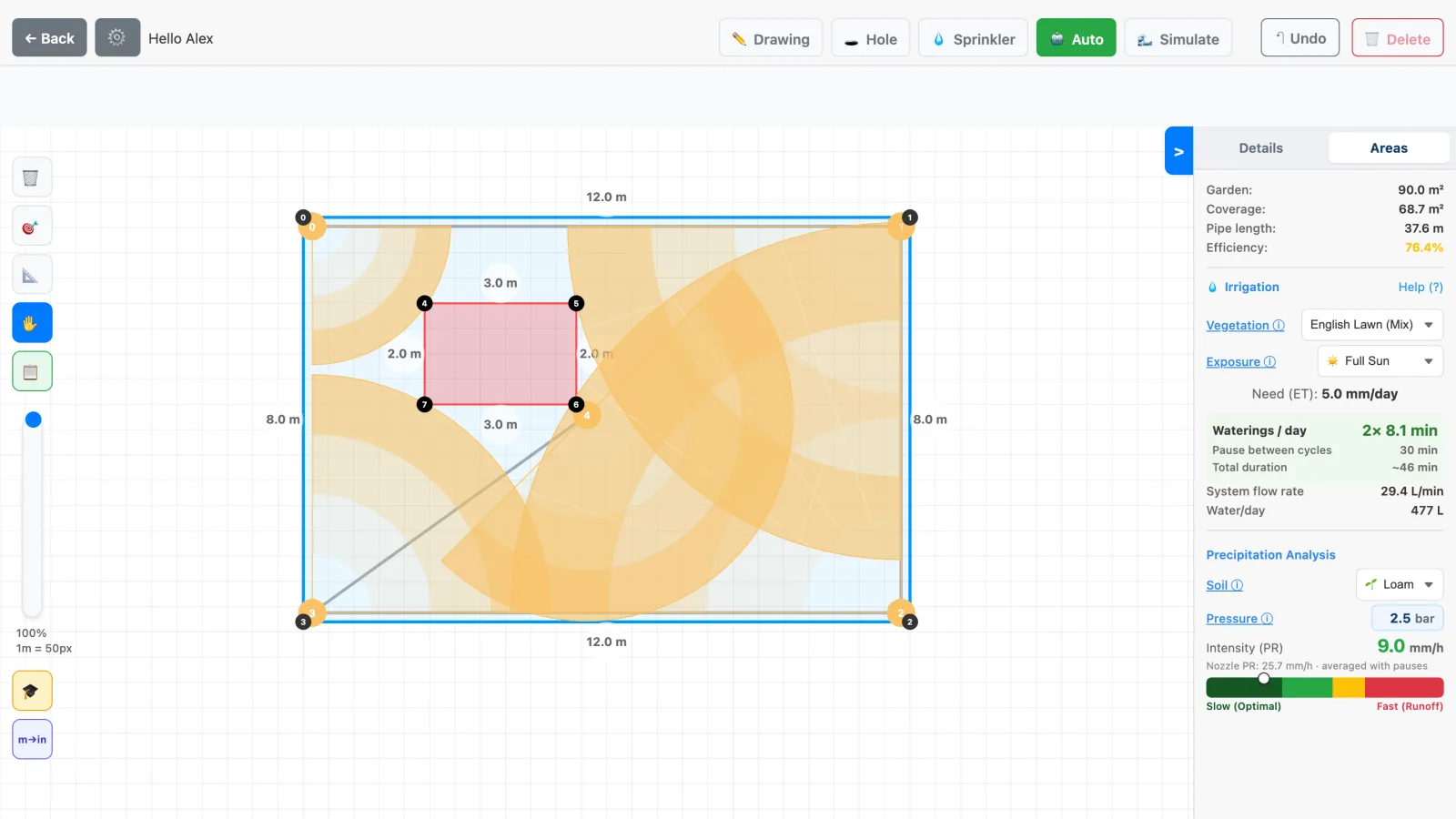
Most guides to smart irrigation open with apps and triggers. We open with the base schedule, because an automation can only correct a program that was right to begin with. On the real lawn in the screenshot, about 970 sq ft, SprinklerMap works out a peak need of 0.20 inch a day from the drawing and the vegetation, and turns it into a single run of about 30 minutes for about 126 gallons: on loam these heads apply about 0.55 in/h (14 mm/h), less than the soil absorbs, so there is no need to split the run into cycles with a soak (cycle and soak).
The automated version of that morning looks like this: the run starts at 5:30 AM and ends around 6:00. The rain gauge can cancel the whole session, the soil sensor can confirm it or skip it, and the weather data stretches or shortens the minutes as the season moves (a June day does not need what an August heat wave needs). If the base program is wrong, automation just repeats the mistake on time every morning. How to calculate run times for your soil is in How long to run sprinklers: minutes per cycle by soil and head type, with the math behind them, and how to split zones by plant type is in Hydrozones: split your garden to irrigate better.
The checks a smart schedule makes before every run
Is it raining, or did it just rain? A wired or wireless rain sensor answers this locally and instantly, with no internet. Its weak spot is that it resets as soon as it dries, while the lawn can still be soaked. More on placement and adjustment in Rain sensor for irrigation: legal requirement and how it works.
Is rain on the way? Rachio and Orbit B-hyve check the forecast on their own and skip a cycle when enough rain is expected. In Home Assistant you can do it with a free forecast integration such as Open-Meteo, which needs no API key: if more than 0.2 inch is forecast in the next 6 hours, skip the morning cycle.
Is the soil still wet? A soil moisture sensor in the root zone is the most direct reading you can get. A common rule is to water below about 35% volumetric moisture and hold above 60%, but the right numbers depend on your soil: sand drains and dries fast, clay stays wet for days. Calibrate by checking the soil by hand for the first couple of weeks.
Is it freezing or blowing? Block every zone below about 37 °F and restart only once it is back above 41 °F: ice on sidewalks and driveways is a liability, and water freezing in a riser can split it. In shoulder seasons this check matters more than the rain skip. Above about 15 mph of wind, spray heads lose a good share of their water to drift, so a wind skip with no rain in the forecast is worth adding too. Freezing for the whole season is a different job: that calls for winterizing the system, covered in How to winterize a sprinkler system: drain or blow out, protect the backflow preventer, and restart in spring.

Watering days, WaterSense and rebates
Many US cities limit watering to certain days (odd/even addresses, or set weekdays) and to early-morning or evening hours during summer. Your automation has to live inside that window: most smart controllers have an odd/even or day-restriction setting, and in Home Assistant it is one more condition on the trigger. A rain skip that moves the cycle to a non-allowed day is a fine waiting to happen.
Weather-based controllers can carry the EPA WaterSense label, which means they passed a test for adjusting watering to local weather. EPA's estimate for a typical home is roughly 7,600 to 15,000 gallons saved per year, depending on the system and how it was run before. Many water utilities offer a rebate, and most require the model to appear in EPA's WaterSense product search, so check your utility's page before you buy. Amounts vary: Corvallis, Oregon, for example, pays 50% of the price up to $75.
Seasonal adjustment and evapotranspiration
Evapotranspiration (ET) is the water the lawn loses in a day, through the soil surface and through the grass itself. A hot, windy July day around 90 °F can pull 0.24 to 0.31 inch out of a lawn; a mild day in spring, a fraction of that. Rachio, Hunter Hydrawise and Orbit B-hyve estimate it from local weather (temperature, humidity, wind, sun) with the Penman-Monteith method and scale run times every day. The background on the method is in Why Evapotranspiration Is the Foundation of Modern Irrigation: the FAO-56 Paper Explained.
Without ET you can get part of the way with a monthly percentage: 100% in July, about 70% in September, about 40% in October. Most controllers call this seasonal adjust. In Home Assistant it is a number helper that multiplies the run time, or the Smart Irrigation integration, which keeps a running balance of water lost to ET and water added by rain and calculates the minutes for you. It calculates durations, it does not open valves: you still connect it to your controller or valve.
Three ways to build it
The controller's own app (Rachio, B-hyve, Hydrawise). The fastest route: the weather skip, seasonal adjust and watering-day rules are built in, and you configure them in minutes. You give up some control over the exact rules, and the smart part depends on the cloud.
A Tuya / Smart Life hose timer or controller. Cheap and easy for one or two zones: schedules, manual rain delay, app control, and voice control through Alexa or Google Home. Conditional automations on sensors only work with devices from the same ecosystem, so check that the sensor is supported before buying. More on choosing a controller in Smart sprinkler controllers: what WaterSense and Wi-Fi save, rebates, and when the upgrade pays.
Home Assistant. Two patterns work well. In the first, the controller keeps its own schedule and Home Assistant only watches and adds rain delays: the Rain Bird integration, for instance, exposes a rain-delay number an automation can raise when the forecast turns wet. In the second, Home Assistant owns the schedule and opens the valves itself. The second gives you every rule you want and keeps working without internet, at the cost of building and maintaining it.
Voice assistants are an add-on, not the brain. Linking Smart Life or B-hyve to Google Home or Alexa takes a few minutes through the brand's skill, and lets you say "start zone 1 for 10 minutes" or build a routine on temperature. Both run through the cloud, so they stop when the internet does.
Where weather automations go wrong
Latency. Cloud controllers check the forecast every 1 to 6 hours, so a rain skip can arrive after the rain has started. Pair the forecast with a physical sensor: the sensor stops the cycle right now, the forecast cancels the next one.
Distance from the weather station. Forecasts and ET usually come from the nearest airport or public station, not your yard. Near a lake, on a slope or in a valley the difference shows. A personal weather station such as Ecowitt or Davis, connected to Home Assistant, fixes it.
A sensor nobody checks. Soil sensors drift, batteries die and rain sensors get covered by a growing shrub. Set notifications for cycle started and finished, skip reason, zone not responding and low battery, and look at them once a week. A pulse-output flow meter on the main line tells you how many gallons each zone used, and a sudden jump points to a broken head or a leak before the water bill does. The full smart setup, sensor by sensor, is in Smart garden: how to design an intelligent irrigation system, and the basics of programming a regular timer are in Irrigation controllers and timers: how to choose the right model.
Frequently asked questions
Does the automation still work if the internet goes down?
On cloud controllers (Rachio, Orbit B-hyve, Hunter Hydrawise, Tuya-based timers) the last saved schedule keeps running from the controller's own memory: you lose the app, the weather adjustments and the rain skips until the connection is back, but the zones still fire. Home Assistant with a locally controlled valve or controller keeps everything running, because the logic never leaves your network.
How much rain should cancel a watering cycle?
A good starting point is about 1/4 inch (6 mm) measured, or 0.2 inch (5 mm) forecast for the next 6 hours. On clay, drop it to roughly 0.15 inch: clay holds water near the surface longer. Then adjust after a few weeks by checking the soil with a screwdriver or a probe the morning after a skipped cycle.
Do I need both a soil moisture sensor and weather data?
They answer different questions. The forecast tells the controller rain is coming; the soil sensor tells it the lawn is still wet from the storm two days ago. Each one misses cases the other catches, so on a lawn that matters to you it is worth running both.
Recommended products
These product links are affiliate links: if you buy on Amazon or AliExpress through them it costs you nothing extra, but it helps us keep SprinklerMap alive as a project and create new useful content.
These products are catalogued in our brand database, with the same description and price range you find on the manufacturer page.

| Model | Type | Description | Radius (m) | Price (€) | Buy |
|---|---|---|---|---|---|
| ⚙️ GW2000 Gateway | Accessory | WiFi gateway required to connect Ecowitt sensors (up to 16 WH51) and IoT devices like the WFC01 to the WSView Plus app and to Home Assistant. | — | €48-70 | Amazon |
| 📡 WH51 | Sensor | Wireless soil moisture sensor. Transmits every 16 s, 20 cm depth, range −40 °C/+60 °C. Integrates with Ecowitt gateway and Home Assistant. | — | €20-35 | AmazonAliExpress |
| 🖥️ WFC01 WittFlow | Controller | Smart irrigation timer that connects to the Ecowitt gateway as an IoT sub-device: it can be triggered automatically based on the WH51 soil moisture sensor's data, without needing a separate controller. | — | €55-80 | Amazon |
Other suggested products
Products not in the brand catalogue: generic material, tools and accessories where the right size matters more than the brand.
| Product | Description | Price (€) | Buy |
|---|---|---|---|
| Sonoff SNZB-02D Zigbee temperature sensor | Zigbee temperature and humidity sensor with LCD display. 2-year battery life. Ideal for frost detection to protect the irrigation system in winter. | ~€12-20 | Amazon |
| Shelly 1PM smart relay with power meter | WiFi relay with integrated power meter. Monitor pump consumption and automate switching. Compatible with Home Assistant. | ~€15-25 | Amazon |
| Raspberry Pi 5 + case for Home Assistant | Raspberry Pi 5 with ventilated case for Home Assistant OS. Self-hosted platform for advanced automations without cloud subscriptions. | ~€60-90 | Amazon |
| Product | Description | Price (€) | Buy |
|---|---|---|---|
| 2-zone WiFi irrigation timer (Tuya) | Smart 2-zone WiFi irrigation programmer, compatible with Smart Life and Alexa. Hourly schedules, manual rain delay, remote app control. A budget option for one or two zones on a hose bib. | ~€15-30 | AliExpress |
| Zigbee temperature & humidity sensor (Tuya) | Compact Zigbee 3.0 temperature and humidity sensor. Up to 2-year battery life on CR2032. Compatible with Zigbee2MQTT and Home Assistant for frost-protection automations. | ~€8-15 | AliExpress |
Technical note: Smart controllers and sensors change with firmware updates, and not every device works with every valve, controller or home network. Check compatibility on the manufacturer's site before buying. We have not tested the models named here hands-on: the comparison is based on the specifications the manufacturers publish. Watering-day rules and rebates are set by your local water utility, so check their page for the current details.